Lip-syncing AI tools have become a major part of video creation in 2026. These tools allow creators to match speech with accurate mouth movements, making videos look natural without recording real footage.
With the growth of AI avatars, talking photos, and multilingual content, lip synchronization is now essential for content creators, marketers, educators, and businesses.
What is Lip Synchronisation AI
Lip synchronization AI is a technology that aligns spoken audio with mouth movements in a video or image. It ensures that lips move exactly according to the words being spoken.
This is achieved through phoneme-to-viseme mapping, where sound units are converted into matching mouth shapes. Lip-sync can be applied to both real videos and AI-generated avatars.
How Lip Sync AI Tools Work
Lip sync AI tools follow a structured process to generate realistic results.
First, the system converts speech into phonemes. Then, it maps those phonemes into visemes, which represent mouth positions.
Finally, the AI animates the face based on these mappings. Machine learning continuously improves accuracy, making the output smoother and more realistic.
Types of Lip Sync AI Tools
There are different types of lip-sync tools designed for specific use cases.
Talking photo tools animate static images into speaking videos. AI avatar tools create complete videos using digital presenters.
Video dubbing tools replace original audio while maintaining lip-sync. Some advanced tools also support real-time lip synchronization for live avatars.
Top 5 Lip Synching AI Tools in 2026
Zoice (Best Overall)
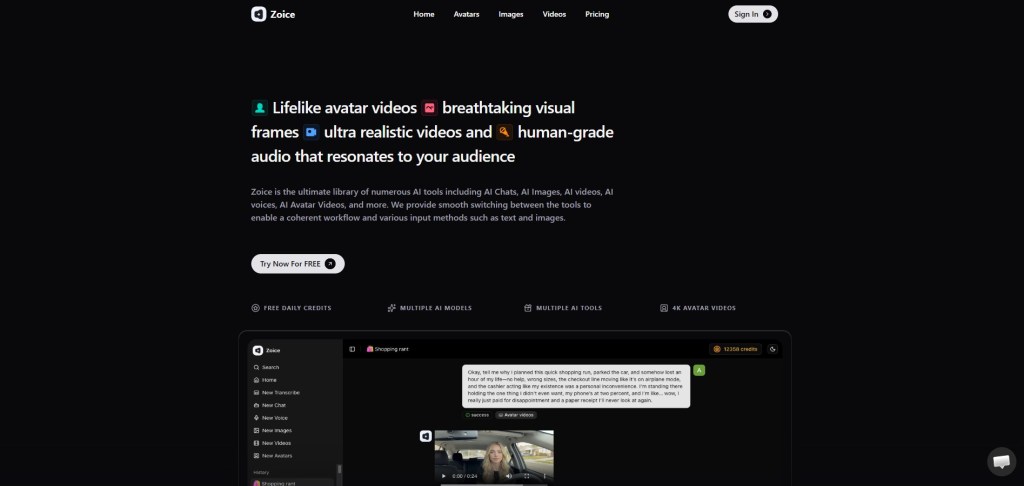
Zoice is the most powerful and complete lip-sync AI tool in 2026. It combines talking photo animation, AI avatars, and voice generation into one platform.
It delivers highly accurate lip-sync with natural expressions and human-like voices. Zoice is beginner-friendly and allows users to create professional videos in minutes.
It is best for content creators, marketers, and businesses looking for an all-in-one solution.
Key Features
{AI avatar creation
Create realistic presenters with accurate lip-sync}
{Voice cloning technology
Replicate your voice for personalized videos}
{Multilingual video generation
Create content for global audiences}
{Lip-sync optimization
Precise mouth movement matching with speech}
Pricing
Free Plan – $0/month (50 credits per day)
Starter – $7.99/month (4K credits per month)
Basic – $29.99/month (17K credits per month)
Creator – $49.99/month (30K credits per month)
Agency – $89.99/month (50K credits per month)
HeyGen
HeyGen is a professional AI video tool that creates avatar-based videos with strong lip-sync accuracy.
It supports multiple languages and natural voices, making it ideal for marketing, training, and business communication.
Synthesia
Synthesia is known for its realistic avatars and precise lip-sync technology. It supports over 100 languages, making it perfect for global content creation.
It is widely used for corporate training, presentations, and e-learning.
D-ID
D-ID specializes in turning images into talking videos. It offers fast lip-sync generation and is easy to use.
It is best suited for quick content creation, social media, and personal branding.
Magic Hour
Magic Hour is a creative AI tool known for its high-quality lip-sync and animation capabilities.
It is ideal for storytelling, creative projects, and experimental video content.
Features to Look for in Lip Sync AI Tools
When selecting a lip-sync AI tool, focus on key features.
Lip-sync accuracy is the most important factor. Voice quality should be natural and clear. Multilingual support is useful for global audiences.
Facial realism and expression control improve engagement. Ease of use and export quality also play an important role.
Free vs Paid Lip Sync AI Tools
Free tools are helpful for beginners but often include limitations such as watermarks and fewer features.
Paid tools provide better realism, advanced customization, and high-resolution exports. They are more suitable for professional use.
Choosing the right option depends on your budget and content needs.
Use Cases of Lip Sync AI Tools
Lip-sync AI tools are widely used across industries.
Content creators use them for YouTube videos and social media. Businesses use them for marketing and advertising.
They are also used for video localization and dubbing. In education, they help create engaging training and learning content.
Tips for Better Lip Sync Results
Use high-quality audio to improve accuracy. Choose clear and front-facing visuals for better animation.
Match the voice with the character’s personality. Keep animations natural and avoid over-editing.
Testing different settings can help achieve better results.
Common Mistakes to Avoid
Avoid using low-quality audio or blurry visuals, as they reduce realism.
Do not ignore lip-sync accuracy. Poor synchronization can make videos look unnatural.
Avoid excessive effects and choose the right tool for your specific use case.
Future of Lip Sync AI in 2026 and Beyond
Lip-sync AI is evolving rapidly. Real-time lip-sync for live avatars is becoming more common.
Hyper-realistic digital humans are improving. Multilingual dubbing is becoming more accurate and automated.
Integration with AR and VR will create more immersive digital experiences.
Conclusion
Lip-syncing AI tools are transforming how videos are created in 2026. They make it easy to produce realistic and engaging content without traditional filming.
Choosing the right tool can improve your results and save time. Whether you are a beginner or a professional, these tools offer powerful solutions for modern video creation.
FAQs
What is the best lip-sync AI tool in 2026?
Zoice is considered the best overall due to its all-in-one features and realistic output.
Are there free lip-sync AI tools available?
Yes, many tools offer free plans, but they come with limitations.
Which tool is best for beginners?
Zoice and D-ID are great options due to their ease of use.
Can lip-sync AI translate videos?
Yes, some tools support translation while maintaining lip-sync.
Is lip-sync AI safe to use?
Yes, most tools are safe if you use trusted platforms and follow their privacy policies.


Leave a comment